
Home / Why Rats Keep Coming Back After Traps
You Caught Five. The Hole Caught Fifty.
“Set four traps in the attic last month. Caught two rats. Thought that was it. Three weeks later they’re back.”
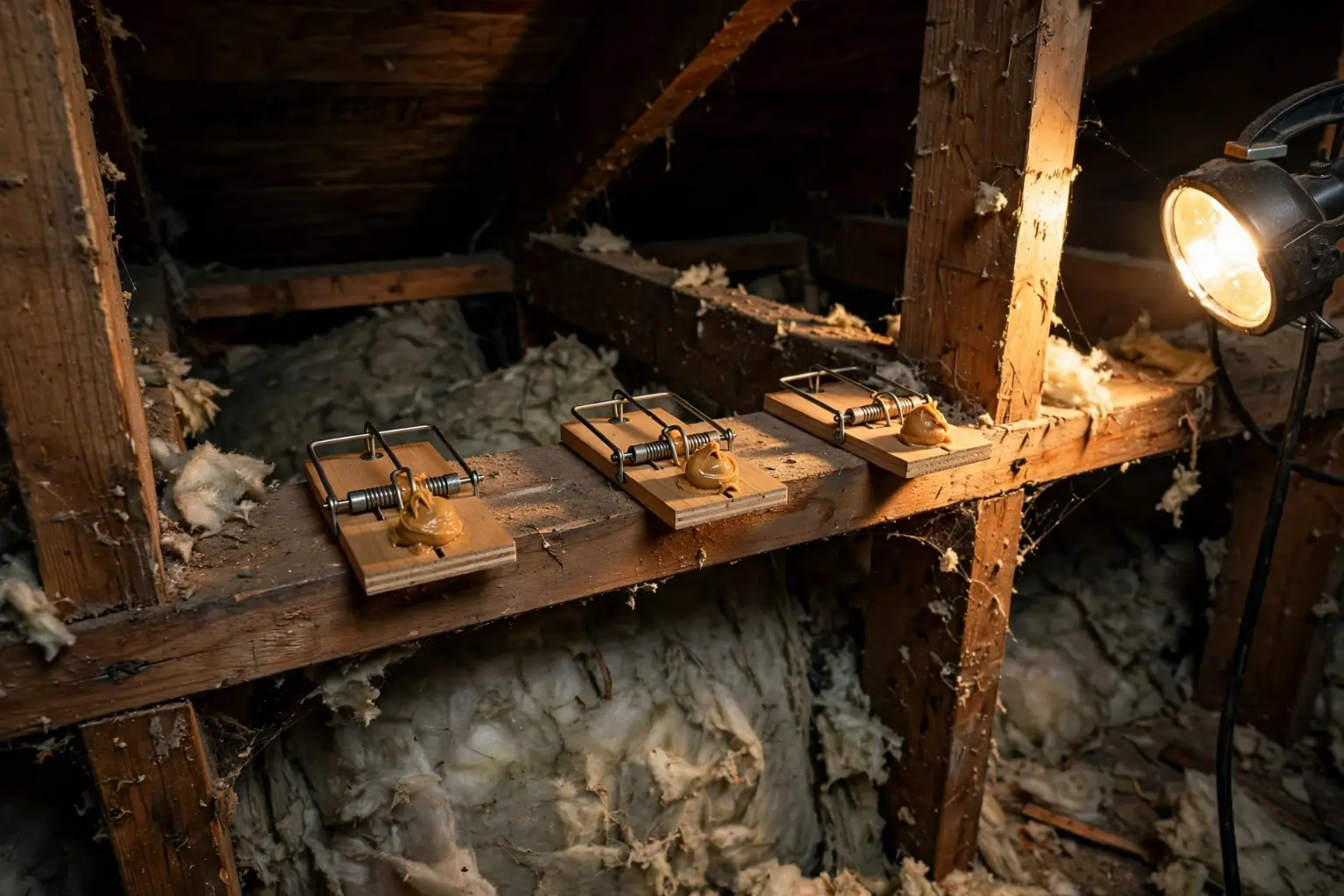
The Core Reason: You Removed Animals, Not Access
This is the most consistent pattern we hear on calls from Spring Hill homeowners who’ve already tried to handle the problem themselves. The traps worked, they caught animals. The problem returned, because the traps never addressed the actual issue.
A snap trap in your attic catches the individual animals currently inside the structure. It does nothing to the quarter-size gap in your soffit panel where they’re entering, or the deteriorated vent screen on the east slope, or the open utility penetration at the roofline that a roof rat finds on its nightly territory run.
Within 2 to 3 weeks of removing the interior population, that open access point attracts replacement animals from the surrounding population. In Timber Pines, Woodland Waters, or any canopy-connected Spring Hill neighborhood, the surrounding roof rat population running rooflines nightly is a constant source of replacement animals for any unoccupied but accessible attic space.
The trap solved the wrong problem. It addressed the animals present without addressing the access that allowed them to be present.
The Florida Factor Makes This Worse
In northern states, a homeowner who traps through fall may at least slow the problem during winter when breeding decreases. In Hernando County, roof rats breed every month of the year. A pair left in the attic after the trapped animals are removed begins producing litters while you’re assuming the problem is resolved. A population of 3 that enters in August becomes 8 to 10 by October without intervention, and 20 to 25 by February.
The math works against trap-only approaches in Florida more than almost anywhere else in the country.
Why Adding More Traps Doesn’t Solve It
When traps don’t produce lasting results, the instinct is to add more, larger snap traps, bait stations, live traps. This catches more animals while the same unsealed access points allow more to enter. The return cycle shortens, the frustration increases, and the attic contamination continues accumulating throughout.
More traps is not the answer. The answer is: find every entry point, seal every one of them with stainless hardware cloth that rats cannot chew through, and then trap the animals already inside. This is the sequence that ends the return cycle.
What Proper Exclusion Requires
Exclusion in Spring Hill starts with a ladder inspection of the full roofline, not a visual check from the driveway. The most common entry points in Timber Pines and Sterling Hill homes are the soffit panel gaps at rafter tails that are invisible from below. They’re only findable from a ladder with hands on each panel checking for movement.
After every entry point is mapped and sealed, mechanical traps are placed on the documented travel routes inside the attic. Return visit at 7 to 10 days confirms the population has been removed and the exclusion is holding.
Frequently Asked Questions
Why do rats come back so quickly after I catch them in Spring Hill?
The entry points are still open. New animals from the surrounding population, running rooflines nightly in wooded Hernando County neighborhoods, find the same unsealed soffit gaps or vent screens and enter within days of the prior occupants being removed. Exclusion of every entry point is the only step that stops the return cycle.
Does catching rats in traps mean the infestation is getting smaller?
It means you’re removing animals from a population that’s continuously replenishing through open access points. Without exclusion, the interior population rebuilds toward its prior level within 2 to 4 weeks. Trap catches confirm the infestation is active and the trap placement is correct, they don’t confirm the infestation is shrinking.
How many entry points does an average Spring Hill home have?
3 to 5 on average for Spring Hill homes from the 1990s to 2000s. Older construction in Timber Pines, Brookridge, and Brooksville typically presents 5 to 8 on a first-time inspection. Complex rooflines can have more. This is why a ground-level visual check misses most of them, the gaps are at the rafter tail edges, only visible from a ladder with hands on the panel.